Welcome

Lifedrivedoc.com began as a place to talk about the Lifedrive. It soon became apparent that it was much more than that. Since moving on from my Lifedrive, I am engaged in more avenues of technology. That technology has intersected with my professional life - Medicine as well as my social life.

As noted above, the blog is about a lot of things in relation to technology. If you are looking for Lifedrive related material, I am currently dividing the blog so that those searches will be easy for you to find. Most of them will be pre 2007, that should help. Additionally, if you are looking for the links that used to be on the left border. They will be back up in a different format soon. I do enjoy reading about new things to do with the Lifedrive, so you can feel free to let me know about those. I will also post those on the site.

If you are having trouble getting an RSS Feed, click on the feed link below or type this into your reader: http://feeds.feedburner.com/lifedrivedoccom


Enjoy.
Showing posts with label Review. Show all posts

Tuesday, December 28, 2010

The Best Device for 2010.....

Folks, I know the iPad has had the reputation of being the best device for 2010.  It's on the wish list of many, but here's a story that may make you go Mmmgh?

I had the opportunity to purchase an iPad earlier this year.  It was a gift actually that was to be given to me some time in August.  I passed on the gift immediately.  I was told about how many wonderful apps that were available for it and how the simple act of buying an app once meant that it could be utilized on an iPhone and an iPad.  I was shown the simplicity of reading books and the running of gadgets from remote controlled apps.   I thought that this was wonderful.

However, I declined the iPad!   Yes, folks, I declined the hottest gadget of the year.  The gadget that is simply the best in its class - that of Tablet Computing.  So I know that you are asking the very question that many of my other friends have asked:  WHY?  And more importantly, what is the best gadget, in your opinion, for 2010?

For me, the gadget of the year is quite simply Amazon's KINDLE.

What I did not tell you in the first paragraph above was that I have a very large library of books.  Books that I never get to carry around with me.  They range from novels to sonnets to medical literature.  I have well over 1,000 journals, which I rarely get the chance to read and therefore am subjected to buying a subscription to a Journal Reviewer, reading in depth the articles that are germaine to me.  I rarely get the opportunity to read novels and when I do, I usually don't have the book with me.   What I needed was an electronic book device.  Something that just did electronic books.  I did not want something with email, twitter, You Tube or any such distractions.  I wanted a serious e-book reader.  No tweeting, beeping, ringing interruptions.  Just words on a page.  I wasn't interested in color or pictures.  Just WORDS.

The Kindle or more importantly, The Kindle 3 is perhaps the best e-book reader ever invented.  As of 2010 of course.  The iPad simply does not compare when it comes to reading a novel on the device for over an hour.  I tried to read on an iPad that was loaned to me and I immediately became fatigued trying to read at night.   Additionally, the iPad, excellent as it may be as a mobile utility device, is much too heavy to be considered a dedicated e-book reader or book replacement. It is too distracting, with its apps, alerts etc., to be considered a serious e-book reader.  Now, I am not putting the iPad down, but simply stating that if you are looking to read books and only books, then the Kindle is the better choice.

So, are there weaknesses to the Kindle?  You bet.  First, you really do need to have the same brightness that you would have to read a regular book available to you.  Otherwise, you will need to buy a cover which has a built in light source or buy another light source.  There is no back light, as seen with the iPad. 
Second, if you are into color pictures, the iPad is for you.  The Kindle shows only gray scale images.  Again, it is for reading.  Thus I would not recommend it for Magazine reading.  Nor would I recommend it for PDF books.  The manipulation that needs to go on with trying to read a PDF is just not feasible for long articles.
Third, after playing with the iPhone, any Smart phone or an iPad or iPod Touch, you have this feeling that everything that has a small screen needs to be touched to make the words and images move.  Thus page turns, character enlargement etc., are intuitively managed by Touch Screen -- On An iPad.  But not on a Kindle.  There are still ancient Touch buttons on the side and a relatively antiquated hard key keyboard.

But what beauty there is lies in the Software that Amazon has chosen to use.  Let me first say that Linux is always loved and the OS appears to be a version of this.   You can add books to the Kindle in many different ways.  You can use Amazon's WhisperSync which does over-the-air downloads via 3G or Wifi.  And did I mention that the 3G is free, without registering?   Yes, it's relatively slow if you want to surf the web, but for obtaining books, it's wonderful.  You can also Archive by just erasing a book off your KINDLE.  You can save an entire folder, which contains all of your books from the KINDLE to your PC.  This is great if you want to upgrade a Kindle.  You just download the folder and store it on your hard drive.  This also allows you to save files on the Kindle and use its 4 gig memory as a hard drive.  You can upload Audiobooks via this route also or MP3 files.

One amazing feature that I loved was during an hour of reading a classic.  I couldn't move, but I had to go to the bathroom.  Well, you can let the Kindle read to you.  It will ( in its really nice phonetic voice, which I might add is quite human-like) continue reading where ever you have left off.  Really great for bathroom breaks :).

The Kindle is small enough to keep in your bag or jacket.  It can download updates if you like, in the background.  Additionally, you can turn off the Wifi and save the battery.  I have used it for 22 days straight on a single charge once.  Normally, I will charge it on weekends though.  What is good however is the ability to read anywhere, anytime.  And if I forget the device, well, I can continue the reading on my phone if I wish.

One important feature about the Kindle is the lack of a back light.  I point this out because it is very important.  I can read a Kindle for at least an hour straight, without stopping because I do not have a large back light shining into my eyes.  That back light is okay if you are reading at 7pm.  But at 10pm, this is a strain.  I have tried reading my iPhone at night and I hate it.  It's too bright.

Of note, the 1000 journals will not be archived.  For that I am actually going to use an iPad.  The PDF restriction is an issue there.  Also, for technical reading, I really would not recommend the Kindle, at least for medical technical reading.  If you have to jump back and forth, several times, then an iPad is better.  But luckily, I have found a wonderful niche for my Kindle.  It is now the proud provider of all of my classic novels and since they are free, the list is now well over 100 in size.  I look forward to reading Moby Dick and Brave New World many years later and from a different perspective than I had before.  The non reflective nature of the Kindle makes it a winner anywhere.  And the fact that I will not be distracted by the web when I am reading is just icing on the cake.

This is why I am calling the KINDLE 3 with WIFI & 3G the best Device for 2010.

Friday, November 05, 2010

One night with Kinect...wow!


So I had the opportunity to use Microsoft's new Kinect yesterday. Having a Wii, I had the opportunity to directly equate the two experiences. With the Wii, you have a unique controller waving in front of a bluetooth band sitting below or atop your television. With Kinect, you bring only your body to the game.

The Kinect device is eery! It is very accurate once it has locked onto who you are. It recognizes the shapes and sizes of individuals with very little effort. I was very impressed. More impressive is the responsiveness of the device. The obvious Wii imitator standard software that comes with the device is actually well worth owning. The games are pragmatic and really do well to simulate the actual body movements of the players. In addition, the ending photo snapshots and video snips can be sent to your facebook page or emailed to individuals. I was particularly impressed with the Volleyball game, which allowed you to Set, Pass and Spike the ball over the net as you would do in a real game of volleyball. With a two player game you can actually feel as though you are in the game itself. I think I may have lost 200 calories during one set!

The video response to movement is almost 1:1. Although I did not get the opportunity to try out the video conferencing feature, I can only imagine that this is also just as good.

What does Kinect feel like if you own a Wii? Well, it feels as though it is a Second Generation Wii, the device that Nintendo would have made next. It is really that good. My wife and kids enjoyed this device as well. We really see that the device has the potential to lead to other things, such as Yoga, video conferencing, real time tutorials with feedback. Throw in Netflix on the XBox and you soon get the idea that Microsoft is trying to lead the Living Room war.

Are there negatives? Well not really. Medically, there is always the question of not having tactile feedback to guide your extensions, but unlike the Wii, I actually feel immersed in the game itself on the Kinect, hence the visual aspects of the game tend to keep me from over extending on a spike and trying small, but varied tactile moves. Nevertheless, the entire family was extremely sore after playing.

As a disclaimer, the actual Kinect device used was from a friend at his house yesterday on the first day of its release. There is no question that I will be getting one as well. I really think that this is a great device. I do understand that Microsoft will be linking this with the new Windows Phone. Nice, but I'm attached to my iPhone. It may bode well for Windows Mobile. Like Microsoft or hate them, I really believe that this product will be a winner for Microsoft. Well done!

LDD.

Wednesday, March 04, 2009

Amazon Kindle for iPhone. WOW!

Okay, so the Kindle may not be for you and the iPhone may be only a thought in your mind as you decide whether to wait for the Palm Pre or succumb to the iPhone.   Although I believe the Kindle and its wonderful books are going to be ported over to the Pre and other devices, the first look at the Kindle for iPhone is, to sum it up in one word:  REMARKABLE.

The application loads in its usual fashion to the iPhone.  However, you have to go to the web and to the Amazon page to get your books.  You can do this from the iPhone or you can do this from the computer.  You must go to Kindlebooks though in order to get the Kindle version.   This is a slight flaw in the iPhone program, since really you should be able to buy the books directly from the program itself.

I did go through the purchasing part on my computer and was surprised to find that my purchase showed up on my iPhone almost immediately.   The pages are well preserved and you can choose your font.  I found it to be a little more responsive than Stanza, the de facto comparison, but a little less than Classics - the snazzy graphics intensive program that has limited open source books available.  

What is nice about this is the fact that Amazon has an amazing library of books, both popular and obscure.  I believe the quoted count for the Kindle was 204,000 (*1).  To be able to access these without having to hook up to iTunes and sync over the air is just wonderful.

The software is 2.9 mb and is a version 1.0 product.  


*1  (From Amazon.com as of 3/4/2009). 

LDD. 

Addendum:

I should note that one can get similar functionality from Stanza, which offers a large selection of books.  However, I do not believe that they offer either the pricing advantage or the sheer volume of books that Amazon does.  However, Stanza is a great product that is a must have if you have an iPhone.   The major differences appear to be in Stanza being a little more graphics intensive, which tends to run down the batteries a little faster.  But both are very good. 

LDD.

Friday, November 09, 2007

Whoa! FREE PEDIATRICS TEXTBOOK


Whoa! Stop the presses! Could this be correct? Well, as I perused the Universe looking for a Pediatric document, I ran into this web site. The University of Hawaii's professors have put together an online Textbook with questions and answers at the end of each chapter.

If you are a Family Physician, Midlevel provider or Medical student looking for some basic information in regards to in-hospital or outpatient Pediatrics, this is is a wonderful online source.

So confident is this group that they have made the hefty document available online in a Word document and pdf file format. Or can you say "Lifedrive compatible" and "iPhone compatible" file respectively :) ?

The data is spot-on, at least for many of the basic cases. The interactive introduction to a case, followed by a detailed response, with a basic medicine lesson taught in the interim, is especially nice. To top it off, there is a question and answer session at the end. Very Socratic!

I think this is a great addition to any Palm Device. It would fit perfectly in a Treo with either Documents or Mobi Office attached.

Kudos and many thanks to the professors at the University of Hawaii for sharing this wonderful gift. It is obvious that a lot of work has gone into this and making it available for everyone is truly wonderful.


LDD.


Thursday, September 13, 2007

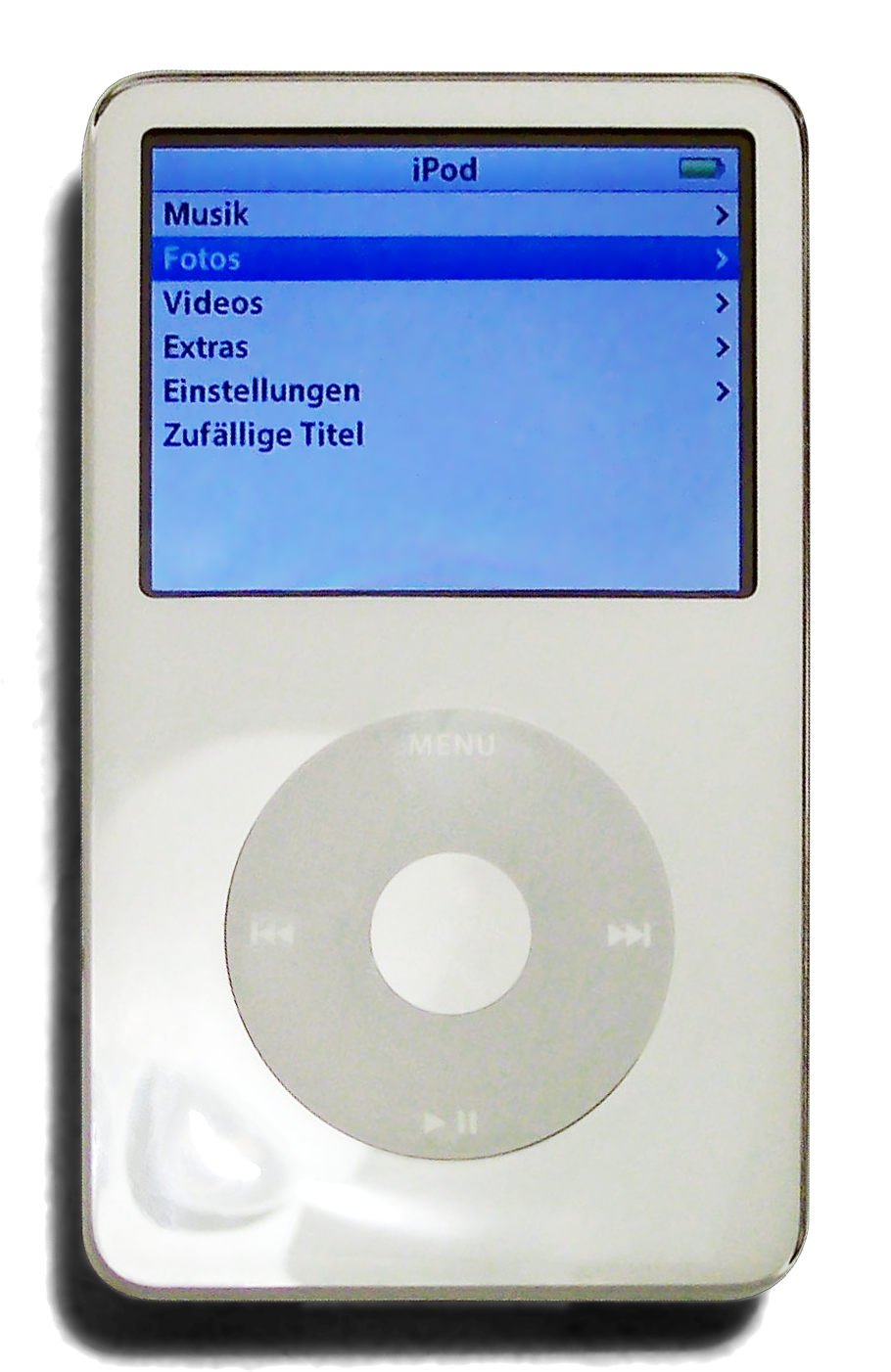
Emptying the Pantry: First thoughts on an iPod and my Lifedrive.

*** This article was written on April 11, 2007, I forgot to release it. It was written before the new iPods were released last week. ***


So Christmas was a good time of the year for me. I received an iPod and was somewhat concerned because I have been relatively happy with my Lifedrive for all of my multimedia needs, particularly podcasts.

However, after using my iPod daily for 3 months now, I cannot believe how I have been able to live without this device for so long. The Lifedrive is no comparison to the iPod when it comes to multimedia. There are a few positives that make the Lifedrive worthy, but the advantage in terms of simplicity is something to behold.

First of all, iTunes is an unbelievable piece of software. Unlike some of its predecessors, such as MusicMatch, the iTunes music player is not a collecting ground for spam nor does it burden you with having to make categories and editing.

What is nice, is the fact that all of your podcasts are located in a podcast aggregator in iTunes, thus several very good medical podcasts that I listen to on a regular basis, are easily updated without my having to go to the websites to download them. The old episodes are immediately erased from the iPod once they have been listened to or I can change the rules in iTunes.

There are small nuances with the iPod itself. First of all, when the headphone is pulled out of the iPod, the iPod pauses, so you do not miss the podcast or song that you are listening to. To add to this, the form factor of the entire ipod series is essentially flawless. It is easy to carry, light and aesthetically pleasing.

So, how does this compare to the Lifedrive. Well the Lifedrive cannot match the iPod in physical weight. It is a heavy device that is tempermental. But it still has a lot going for it as a multimedia device. First and foremost, it is not tied down to one piece of software for its multimedia data. In fact you can obtain multimedia data from just about anywhere that can store something on an SD card or wirelessly. Secondly, it can play many more formats of movies and even podcasts without being converted. The addition of a 4gb SD card means that you can use a usb/sd card combo (see my previous writings about the card that I voted as the best Lifedrive gadget/software accessory for 2006) anytime and any place.

Picture storage on a Lifedrive would have been excellent if Palm had remembered to release the promised stand alone Memory Stick convertor for Sony cameras. It was one piece of vaporware that never made it. The SD card memory cards are quite good and the Lifedrive software does a good job in transfering that information to the device itself.

Of obtaining data, the Lifedrive excels beyond the 5th Generation iPods in that movies, readable data, music etc. all have three entry points for download. Accessed via the wireless web, data can be obtained via bluetooth, infrared or 802.11. The latter being by far the fastest method. There is also the SD/usb card option mentioned above. This is something that is quite adorable in the Lifedrive and has saved me on many occasions. The Lifedrive, like the iPod can also be used as an optional USB disk drive. BUT I CAUTION YOU NOT TO DO THIS. You will invariably run into a reset loop when you return to run your normal programs.

What of crashing? Well this is where the iPod has been overrated. You may remember many months ago I posted an article wishing for Apple to make a PDA because of the fact that Apple knows how to utilize the memory etc., without causing crashes. Well, I would like to take all of that back! The iPod does crash! But it crashes silently. The iPod doesn't do resets, in the true sense of the word, during song or movie playbacks. No, it will do it when you turn off the device after watching a movie or rummaging through several playlists. When you turn it back on, you are met with a dark screen. You almost swear that the device is broken, but looking very closely, almost requiring a tilt of the screen is a small silver Apple Logo in the center of the screen. What's going on? A silent reset that takes about 15 secs max for a 30 gigabyte iPod. It's almost predictable. However that is acceptable given the Lifedrive's woeful 3-5 minute soft resets, which often occur during critical moments. The question here is whether this blip in the Apple device accounted for the reason why Apple may turn to complete flash memory as they appear to be doing. See the iPhone and Nano series.

So, it all boils down to what you want to do with a device. As noted by Ed Colligan, the Palm CEO, the company has recognized many of the mistakes that have been made and they are taking a page out of the Apple playbook by using Linux (Apple's OS X and presumably the iPod and iPhone are running various versions of Unix) for their next offerings later this year. But let's not forget that the Lifedrive was meant for not only multimedia play but for serious use, ie. Spreadsheets, Database entry etc. and the Multimedia wizadry is something new for them. Apple has not ventured into the Handheld arena since the Newton. But they have learned and I think that Palm will take into account the need to get rid of the Hard drive solution and venture to the flash memory option to save battery life and provide a good user experience. For now, the Lifedrive remains a distant second when compared to the iPod, despite the many on-paper advantages that it has, including its own set of speakers. The out of the box quality and attention to detail and user experience appears to be in Apple's favor right now.


LDD

Tuesday, April 17, 2007

Short Blurbs from Around the Lifedrive Universe

The following is a list of short blurbs from around the Lifedrive ecosystem:

(LDD) Slingbox support for the Lifedrive is still lacking. According to a report on Slingcommunity.com. Perhaps a moot point given the fact that many are dropping support for the device.


(LDD) Intel has essentially dumped Origami and will be focusing on a Mobile Internet Device. This device is smaller, with a mixed platform design and has a quick boot to Linux. This thing looks amazing. For full details, you can go to Intel's developer PDF site for the Developer Document entitled, "Intel Developer Forum: 2008 Mobile Internet Device Overview by Panjak Kedia and Christopher Yahna." Pay particular attention to page 6 to see that this is not Microsoft's UMPC. It is something completely different, faster and apparently Home Brewed for and by Intel. Could this be the Lifedrive replacement? This is a thing of beauty, at least on paper.


(LDD). Khertan, an avid developer, has released updates for Kmeteo to support devices such as the Lifedrive. I am not a user of this, but apparently many of you are. Khertan's website is here.

(LDD). For about a day, I saw a Lifedrive being sold online for $140.00, but it was promptly removed and the site appears dead. If anyone knows of a cheap one, I am in the hunt for one to tinker with. I want to install a CF card to see if there is any improvement in stability. Additionally, I wonder if Linux or OS X can be installed in one of these things?

(LDD). On a few blogs, the question of buying a new or used Lifedrive continues......

(LDD). Ken's vox blog is interesting. He actually owns a Lifedrive, among a host of other gadgets.

(LDD). The indefatiguable Mike Cane posts an interesting article on the Lifedrive and its, well..., obvious problems. But he does it with a twist, sending a blurb to Palm's new blog. Mike is unique, sometimes profane but unarguably honest. You always know where you stand. I like him because he is New York and reminds me a lot of my time spent there many years ago. An interesting read.....As always

(LDD). Interesting question over at Palm's Support site and my answer follows. The reader posted a question in regards to his Lifedrive jumping to the 4 gb newly installed SD Card everytime after a beep and exiting applications.

For others having this problem, you must ensure that you are using a PATRIOT 4 gb card. This is the only Guaranteed card to work in your Lifedrive. I have not had the opportunity to check out the Sandisk, but I would be pretty certain that this will work also (Also Transcend). Software wise, you may want to obtain a copy of Explorer. Also, unknown whether the user officially formatted the card when he/she placed it into the Lifedrive. That could be the beep. If the card reads any more than 3.8 gigs available when empty, then it was probably not formatted.

(LDD). In the better-late-than-never section, MP3PLAYER-review.com has posted a review of the Palm Lifedrive. It's a good review and worthy of a read. But my view is that if you plan on obtaining an MP3 player alone, the iPod has the Lifedrive for dinner. However the site appears to put together the reviews from several different sources throughout the year. Uncertain if this is a legitimate site or not, but it's included here. mp3player-review.com

(LDD). Reminiscing on what could have been. The Palm Infocenter initial review on the Lifedrive in May, 2005.

(LDD). Anyone installing Opera Mini on the Lifedrive? You may want to check out this forum before doing so. Personally, I prefer to wait for a few months before installing anything new on this temperamental device. Still waiting to install Palm Update. Yes, the luddite in me still says to wait. myopera.com

(LDD). Perusing the Lifedrive Universe brought me to this site: giveawayoftheday.com. Interesting software giveaway with forums etc. Appears legitimate. Review of Crystal2mobile done. My take, just use a copy of Apple's Quicktime or some of the free and low cost alternatives available. But the site appears to be well supported.

(LDD). 1SRC special entitled, "I hate my Lifedrive." I don't think I need to say anything more on that one. Very interesting article though. Released 4/4/2007, they are asking for comments. I think that those of you who own the device should go there and express your comments. You should also go to the Palm blog (See link at the blogroll on the left). They really are listening to us.

(LDD). David DeJean writes a very nice and interesting counterpoint to the above in his article in the prestigious, Informationweek.com .
In the article, he delivers a verbose response to Steve Jobs' DRM article; he talks about the Lifedrive as his sole MP3 player with easy upgradability. True, that is one of the strengths of the device. Mr. DeJean writes a wonderful piece in this regard, while having a go at one of our favorite heroes.

(LDD). I cannot believe that we are still seeing crashes from new software by developers on the Lifedrive. I would suspect that a crash in the Lifedrive is a crash in the Treo too, with similar operating systems. But on the iambic forums, there are details of iambics NextDay crashing. This post was written on 4/3/2007. It's now 2 years since the introduction of the Lifedrive and we are still seeing this sort of thing. Can anyone wait for November to roll around to see what Palm does with Linux? The iambic forums site is here.

(LDD). On a lighter note, I perused an interesting site the other day, The Gadget Pastor.
You guessed it, a pastor with a Lifedrive. And to really appreciate this, you have to see the picture on the web site. It is absolutely beautiful. A Lifedrive resting on an open bible with ambient lighting. Pop over to the site to see how he uses his Lifedrive. I found the site to be interesting and was really surprised at his vast knowledge of technology. Perhaps I'm naive.

And that about does it for the News from around the Lifedrive Universe.

Since I've been very busy lately, I haven't had a lot of time to post, but hopefully in the next few months that will change. Additionally, I have scrapped the idea of making a Lifedrive.net website, at least the big plans that I set out to do before October of last year. With Palm dropping the Lifedrive and my busy schedule as it is, the expenditure was neither cost or time effective. Additionally, I did not foresee that I would be this busy. Instead, I will be making a smaller website that will feature a few effective downloads of smartlists and other apps. I think that this scaled-down version will be much more manageable. It will probably be hosted on the Google test site that I have had up for quite a while now. If any of you have some contributions to donate such as smartlists or Handbase files or iSilo (which I will purchase and review soon), drop me a line --> Lifedrivedoc /at/ gmail.com. I will try to get back to you in a timely manner.
I prefer medical apps, but others are welcome.

In addition, thanks to all of you for visiting the Lifedrivedoc.com blog. I am truly appreciative for all of the support over the past 20 months. The time has gone by so quickly. A special shout out to Sammy McLoughlin for your endless support, Mike Cane for your kind words recently, PalmDiscovery and PalmDoc for adding the site to the blogroll. Your kindness is greatly appreciated.


LDD.

Wednesday, January 17, 2007

LIFEDRIVE ESSENTIALS: My top 5 Products for the Lifedrive 2006

So, we are in another year and it's a wonderful time to reflect on the past products that have made the Lifedrive an invaluable tool. Yes, it's true, the Lifedrive is an indelible PIA at times, but I have to admit that last year, without it, I would have been lost.

So, at the end of 2006, I decided to list all of the products that I own, including software, hardware, trinkets etc. related to the Lifedrive. They were not all medical components, but among them I decided to choose 5 products, both software and hardware related and rank them in a top 5 . The Criteria that I used included:

1. My Frequency of use.
2. My importance of use? What happened on days when I did not have the product or the Lifedrive with me.
3. Simplicity in use. Anything that is terribly complex cannot be used on a daily basis.
4. DNC (does not crash). This of course is a major point if you own a Lifedrive.

My final rankings are as follows for 2006 and remember, these are very subjective:


5. TCMP.

There was a scream for a tie between this product and Pennovate's Notes, but this one won out . In the end I had to decide which was used more, my Notes program or TCMP. TCMP won out. TCMP is the program that has made it possible for most Lifedrive owners to not give a darn about the slew of video gadgets (except the ipod video) and MP3 players that have been going around (Although NormSoft's Pocket Tunes is also a screamer for this position, given its deep array of settings). The fact that TCMP has been a free "beta" product for years, gives it the degree of popularity that it deserves. Although its founders are now going on to making a commercial product -The CorePlayer- it has been TCMP that has caught the imagination of just about every Palm device owner.

In August, I purchased one of the first 4 gigabyte SD cards to play movies for my kids and myself while on vacation. During a long drive I was able to view a full 2 hour documentary and a 2 hour movie in addition to a medical lecture that I had postponed watching (Alright, I know I was on vacation, but what else is a geek to do when everyone else is sleeping and you don't have to drive)? The playback was perfect and I have to say that I achieved 5 hours of video time before the Lifedrive gave up on me. Not bad!

But it was TCMP that allowed me to do this without a glitch. This little piece of software was the real ipod killer for me. But that lasted until the ipod video came out. That device created a genre of H.264 videos that just about killed TCMP. The quality of the iPod is superior and has made my TCMP driven Lifedrive somewhat jealous. Attempting to watch video podcasts is next to impossible if "created for the iPod." No such problems with the Sony versions of MP4, but again, the iPod ones do look better.

But I digress! TCMP is a worthy candidate and a must have for your Lifedrive. It is the program that creates a "wow" factor when people look over your shoulder at your "serious" PDA. It was TCMP that I used when I had to show the motions of a joint; and again when I attempted to show a surgical procedure to a patient that one of our local physicians did routinely in his office.


4. Smartlisttogo.

If there was ever a database that had to be bought without hesitation, I would choose this as the database. Smartlistogo has been a GodSend to me and has been responsible for me not jumping to the other side (Microsoft) for a long time. Every time I think that I want something with a little more complexity (ie. Mobisystems Database or Handbase), I am driven back to this simple program.

First you are drawn into its lair of simplicity, by making simple tables of names and addressess, effectively recreating your telephone book. For no apparent reason, other than to say that you can do it! Then, you become fascinated to the point of lunacy as you find new ways to do things. You begin to realize that there is an online manual and you start delving into a tricky arena or relational databases, combining data from one database with another. You then spend 4 hours in complete and giddy geek utopia, discovering that you can set alerts that will show up to tell you that something is due. You salivate at the possibilities: Crossreferencing touchdowns with attempted carries; Number of touches to goal ratio of Arsenal's Thierry Henry; Rating interviewees based on hastily created criteria that you have made up 5 minutes before the interview and then sorting them; creating an app of movies to see; Creating an ongoing bank account app. And of course, listing all of the CME and expense lists that you could possibly create. And then you finally get to the big enchilada. The App to beat all Apps in your mind: The Patient Rounding Application to record not only the patients that you have seen, but to capture all charges while at the point of service. You then create imaginative databases of patients and obstetrical due dates and other things.

So, what happens when you do not have all of this information available? You grind everything to a halt and go back to get your machine. Or you have two machines, an old Palm that has a back up of the smartlist app on it. That is how important this program is. It is the life blood of my Practice for patients that I see outside of the clinic. I can never remember them all and it places them in nice areas that I can recall them.

So what is the downside? The downside to this program is that you must backup everything constantly when you have to rely on it so desparately. But more importantly, it is not encrypted. Thus, you can use real names but you must shut down the entire Lifedrive to protect patient privacy. For myself, I carry an SD card that is encrypted and then decrypted when I have to use it in the Lifedrive.

With the advent of the Desktop App, creation is much easier of a more complex application, although it is nice to see that the application will work on either the computer or the Lifedrive regardless of where the program is made. Although Microsoft Access activity could be better, I rarely use Access and prefer to use the bluetooth method by sending the information to the memos program and printing it out or copying it directly via SD or Lifedrive to the computer and printing it out monthly.

This is a Lifesaver. Literally. I keep equations and formulae, associations and rankings in this product and although I have been looking for more complexity at times and an encrypted file system, the addiction of programming this software is just too much to leave. For the second year running, this is in my top 5.


3. Palm Lifedrive Metallic Case.

So, in July 2005 I received this incredible instrument - The Lifedrive. It is naked! The very next day I went out and purchased an overpriced metallic case and soon find out that this thing is so flawed that I want to bring it back to the store and get my money back.

First, I couldn't get the case to open without ripping the nails of my thumbs apart. I actually had to check my shot record to ensure that I had a tetanus booster. Then, I noted that there was no room for an SD card. Perhaps there was some belief that we did not need one, given the 4 gig hard drive.

So, why on earth would this contraption come in third? Especially since I have now purchased a Rhinoskin case?

Well, I have used this case for almost 15 months and I tried two other cases to see if I could get used to them. I found them all lacking! Even the Rhinoskin is lacking in all of the areas that I want. Secondly, the case now opens easily and readily. But the one thing that this case brings to the table can be exemplified by an event that occurred a month ago.

I was dining at a very nice Japanese Restaurant. While waiting for my table, the kids became restless. The guests who joined us for dinner also had kids the same age. They too were becoming restless. So I took out the Palm Metal Case with the Lifedrive intact and played movies. The case opens up in such a way that the cover molds itself, via hinges appropriately to the Lifedrive. But when the door is pulled all the way back, it produces a stand for the Lifedrive, thus allowing the Lifedrive to stand in Landscape view. PRICELESS.

But this was not the end of the interesting things found with this case. You may recall a piece I wrote called MacGyvering The Lifedrive Jack? Well that came about because of what happened after the playing of Chicken Little. One of my guests, along with my kids decided that once we were called to our table, they would pick up the Lifedrive and hand it over to me. Well, they didn't quite make it! Instead the Lifedrive went to the Floor! A hard, tiled floor. But it was encased and Chicken Little continued unabated. There was not a scratch on my Lifedrive. Oh, the sound eventually died, but the MacGyver tactic worked without a problem.

Protection, Versatility and function all serve to make the Palm Manufactured Metal Case the Number 3 piece of Hardware/Software for me.


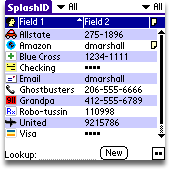
2. Splash ID.


So, it's monday morning and I am up at 5am. I go downstairs for a cup of coffee, listen to the morning news and catch up on some office work. I then run for a half-hour and drive to the
hospital. I receive a call that Ms. Sickly is in the hospital while on my way to the office. I detour and sit to check her data on our computers. I suddenly forget my password, one of 7 that I have to remember and it just so happens, one that I do not use every day, having had no admissions in about 3 weeks. I reach into my pocket and find out that I do not have the PRECIOUS !!! It is still at my bed acting as an alarm clock!

I eventually get the necessary data and return to the office. But at the sight of the last patient leaving for the morning session, I am in my car hurrying back to the house! Why? Because without Splash ID, I have a very good chance of running into the same scenario without being able remember the passcodes for the day or getting help from someone.

If you have to run home at lunch time to get a piece of software, then you know that this product has to be listed in the top 2 of all programs for your Lifedrive. It is so essential that I sometimes question how many times I should back up the data. Once, I even questioned if backing up the data, overwriting the preexisting backup file, will corrupt the backup file! ?

Since November, I have had to have a backup plan! I have chosen to use two other encryption programs not found on the Lifedrive, just in case the day occurs and I have no Splash ID to fall back on.

This is again an essential piece of software, not just for the Lifedrive, but for ALL PALMS!


....drumroll, please, the number one accessory, either Hardware or Software for the Lifedrive is:


1. The Sandisk Ultra II 1- gig SD Card with USB.

This, my friends, is my number one pick for the Lifedrive. This product fulfilled all criteria in terms of necessity, ease of use and frequency.
First, before my family gave me an ipod for Christmas, this was my ipod-killer! It actually created a need. I had to purchase an in-car device to keep the Lifedrive charged while I listened to Podcasts, lectures and music.

So, I can hear everyone who does not own a Lifedrive questioning "why would you need this if you have a Lifedrive and 4 gigs of memory on a hard drive?" The answer to this is not quite that simple. But let's just say that trying to play your songs, podcasts etc from the hard drive was quite problemmatic. There are several delay points and eventual hard resets which make this a thankless task. I wrote something about this a while back (Which Memory do you serve?)

The drive of the Lifedrive is good for one thing --- Storage! Take a picture on your 1 gig SD card and transfer it immediately to the Lifedrive or download a file or a podcast directly to the SD card via USB - for those times when you do not have a cable - and voila it is accessible immediately.

There are a few drawbacks to the SD card approach, but this is mainly a problem with older computers. First, there is sometimes a physical limitation in inserting the SD card into the USB slot. This can be thwarted by using a USB extension or hub, but that defeats the simplicity factor. Secondly, it appears that it works best with just about all USB 2.0 and somewhat touch and go with USB 1.0 or 1.1. Other than that, this is a God Send.

I remember when I had to have a document downloaded as quickly as possible, along with a podcast that I wanted to listen to, on my way to a conference. I was able to go to the website and download the podcast to the SD card, drop my windows document, in the space of 2 minutes to the card and away I went, listening to a CME podcast on my way to a meeting and having the document and speech ready to go. No wires. Additionally, no Itunes aggregator to fool around with, just drag and drop.

The SD Ultra with USB card completes an incredible trifecta of download options what I consider a part of the essentials: The usual linked approach with wires , the wireless simplicity of bluetooth and 802.11 and the aforementioned SD/USB approach. This product makes the Lifedrive a very good tool to own.


Lifedrivedoc's Honorable Mentions:

.
Epocrates

Sensational program for the Palm, with automatic updates. Reason not listed in the top 5: They now have a desktop copy that is even better than the Palm version. I find myself using that a lot more. But if I am on the road or in the hospital, it is still the Lifedrive version that I use.

.
Mobisystem's Office Suite.

I use this as my default word processing and spreadsheet reader and creator. However, it's core products - spreadsheet and word processing are spoiled by the lack of integration of its Database product and drawing program, which crashes the Lifedrive. Additionally, the Database program is not as good at "input" data as it is in comparatively using data. It is pretty and has a lot of "cool" features, but is much better suited as an advanced slide show or picture database program.

I have yet to upgrade to version 7, given the fact that they are using the Opensource PDF maker and viewer which has been notoriously unstable on the Lifedrive. Thus, Mobisystem's Office Suite did not make it into the top 5 this year.

.
Googlemaps.

I went gaa-gaa over this product late last year. A brilliant concept and an even more brilliant program, it is unfortunately only useful to you if you have a very high capacity data mobile plan or plan to do your geomapping from inside of a coffee shop or free wifi area. But it is gorgeous.


.
Pennovate Notes.

A fantastic application. It allows me to use my crabscratch handwriting and save the finished document as a jpg file. Priceless during CME lectures or for jotting down something very quickly. Why is it not in the top 5? Lack of room. I have no negatives to report on this product. It's worth every penny.


.
Rhinoskin Lifedrive Case.

Yes, I do love this case. Infact I am using it now. It has one major asset: A lot of room for saving those SD cards. Additionally, it has a faster access time than the original Palm metal case. So why is the Palm Lifedrive case in the top 5 and Rhinoskin getting honorable mention? On the grand scheme of things, if I dropped the lifedrive in the Rhinoskin, it's goodbye Lifedrive. Beauty gets you only so far.

.
Riley's Kidometer.

An amazing database of facts for children's statistics. Is that heart rate normal for a 3 month old? Is that CBC correct in the newborn? All of these questions are answered in the Riley Kidometer. It is one of the best programs ever written for the Palm. So why is it not in the top 5? Well, I use it only about once per week or two weeks. Again, I have no qualms with this program. It is programming at its best.


Disclaimer: As always, all opinions are mine and there was and is no reciprocal reimbursement or commercial endorsement of any product. I have received no financial or other gains from this report. - LDD.

LDD.

Thursday, September 21, 2006

Near Nirvhana with Nokia


Over the past few months I have been looking for a solution to end my relationship with my favorite phone the Nokia 6310i. The phone has been a beauty for me for many years. It could do everything that I wanted and above all else, communicated with my Palm Pilots 'all of the time.'

During the early days, my faithful Palm Tungsten T would surf the web flawlessly using the bluetooth connection and when the memory of the phone was full in the address fields, the Palm was an amicable substitute with its bluetooth connection to dial friends.

When I purchased my lifedrive, I was a little disappointed that the transition was not seemless, but this ended when Palm came out with a few phone updates that corrected the issue and I was satisfied. So, when an unfortunate stool finally broke the faithful Nokia 6310i, a phone that was dropped, flung, stomped-on, drenched and sat-on (accidentally, of course) finally gave its last electronic blurb, I knew that it was time to move on.

Although "The Brick" (as it has been affectionately called) still continued to work and despite the constant berating that took place from my coworkers, friends and family for carrying such a "large" phone, I enjoyed the seemless nature of it. What made matters worse was the fact that I could not find a replacement and carried the broken "brick" around for almost five months before replacing it.


The Contenders

I looked at the RAZR and, with all of the discounts available, thought that this would be a worthwhile replacement, however the RAZR was actually slower than "The Brick." The menu system was akin to starting Windows. Although the bluetooth connection was nice, it felt clunky and slow. Cute, but not practical.

Next, was the Sony Ericsson. There were many model numbers to choose from but even though they were all nice, with a decent menu system, I could not find a bargain among them. And my rule is: If I have to pay a house payment for a phone, I am afraid that it will not do. So, cute but too expensive.

I looked at a few Samsung models next, but could not find any that came close to matching "The Brick." Most did not support bluetooth, but all had magnificent screens. Infact, I would have to say that just about all of the Samsung phones that I tested had magnificent screens and excellent print and video quality. But again, if I couldn't use it with my Lifedrive, I couldn't use it - period.


Enlightenment.......

Then it came! A glow, the parting of the clouds, an angelic sound through the quagmire of despair. Could it be? ..........

I perused the store looking at a small form factor phone. Odd, was the fact that the phone was a flip phone. Why? Because Nokia is not known for making flip-phones. They, and I say this proudly, MAKE BRICKS !!! BRICKS THAT WORK !!!! But this was beautiful. Akin to seeing the girl of your dreams from a distance and not being able to open your mouth to say hello. It flipped, it's menu system was very intuitive. The address book was familiar, the menu system was familiar and of course bluetooth and infrared all in one package. I turned on my lifedrive and in no-time flat was connected to the internet through the phone. I was able to upload my address book to the phone without making any modifications in the address book sequence. It saved vcards accurately. It's bluetooth connection to my Lifedrive, dare I say it, was actually faster than The Brick. And it timed out after lack of use after 3 minutes, instead of randomly as it had done previously on The Brick, while surfing the internet.

The Nokia 6102i is a splendid phone. It has a small form factor and works FLAWLESSLY with the Lifedrive. There is absolutely no need to download any additional software to update the bluetooth connection. Its affiliation with the address book works flawlessly. There have been some reports that the picture quality is not that great, but for me, I bought the phone to speak to others, not to take pictures.

A real plus is that you can send all of your photos or movies taken from the phone to your Lifedrive via bluetooth or via infrared and clear the memory that way. Additionally, the phone comes with software that connects to your computer which can do the same. Additionally, you can transfer multimedia files from your lifedrive to your phone and vice versa all wirelessly. I have even surprisingly surfed the web via a bluetooth connection with my Lifedrive connected to the phone and conducted a call via the speaker function of the phone.

Worth taking a look, I think that this phone is a worthy successor to the 6310i if you are in the running for a new LIFEDRIVE-Compatible phone. There are many phones that are probably better, but for the incredibly discounted prices that are now out, this phone is very hard to beat.

LDD.

Sunday, July 23, 2006

Patriot Memory 4 gb SD Card. First Hand Account,


On friday I found an article in Palmaddicts on a new memory card released by this relatively obscure company. The company claimed to have a 4g SD card (not the new SDHC or USB 2.0 variety reported in my last article) that was capable of being used by just about any SD-available device.

Well, I was somewhat skeptical of course, but I am off on a family vacation this week and I will need all of the free memory that I can muster on layover flights. Last year the Lifedrive was very handy. I kept a series of movies that the kids could watch while at the airport or if they became unruly on the plane. Our usual DVD player had poor battery life and the Lifedrive was absolutely magnificent, especially when hooked up to a car stereo speaker or via joint headphones. However, the machine would need to be recharged constantly, particularly if I wanted to use it for web surfing.

Thus when I saw this article in Palmaddicts, I immediately remembered that during the year, after a few other plane rides, the battery life was magnificent if the movies were being played from an SD card, rather than the disk drive. 1 gigabyte was okay for podcasts and 2 movies, but 4 gigabytes could ensure very high quality playback and a very peaceful plane and car flight. The ability to watch a few movies and my DVD box sets of "24" , "House" and the first season of "Gray's Anatomy" was just too compelling (I do not watch television and I buy the box sets in the hope of watching these things eventually, based upon recommendations by my wife and friends).

I purchased the SD card yesterday for $85.00. I mention the price, because I paid $60.00 for the combo USB/SD Sandisk Ultra card 2 months ago and $80 for the original Sandisk 1gb SD Ultra card a year ago. The price of memory has declined substantially.

My first thoughts upon feeling the card was how thick and heavy it was, compared to the Sandisk cards. The workmanship appeared to be very good, with no dents, paint errors or sloppy misspellings of the labels. I thought it would be good to just place the blank card in the Lifedrive to see how it would respond. Immediately, the Lifedrive informed me that it could not open the card because it was not formatted. It did not offer formatting options. I branched out of this and discovered that the card did not show up in the right upper dropdown display. I then performed a soft reset, remembering that this tends to clear the memory. Not only did it clear the memory, but it formatted the card to FAT-32. I checked the memory of the card, using INFO and found that I had 3.8 gigabytes available. Sounds familiar !!!! I think the Lifedrive Disk had the same amount of available memory when it came out of the box.

I then placed the card in a card reader and began to use it as a regular computer directory, uploading my home movies and the aforementioned programs. I also downloaded a fresh copy of TCPMP and its associated AAC plug-in. I placed this in the already-provided Palm/Launcher directory (appeared after the lifedrive formatted the disc) . If you look at my previous post, you will note that TCPMP tends to crash a lot less often - if at all - if it is run from the SD card.

Voila !!! Success. The SD card runs perfectly on the Palm Lifedrive. There is almost no delay in access times. I can fast forward, reverse, enlarge, rotate and skip as with the Sandisk 1g cards and faster than if I used the harddrive. Access times appear to be comparable to the Sandisk, although I did not do a formal study to test this.

The SD card is a winner in my book. I am thinking of picking up another one to emulate the Ipod nano. Having a full 8 gigabytes of memory at my disposal is very nice. Infact, if you told me that I would have 8 gigabytes of memory on a Palm 5 years ago, I would have asked "what for?" Today, we have programs and files that can access and make useful this type of memory. The new SDHC cards that will be released this year will add even more capacity to these incredible tools of ours. If the Patriot Memory card is a peek at what is to come, hang on to your hats.

In the medical field, I think that the time has come for on-demand medical video. Medical videos are just as tedious to watch for those of us in the medical profession as it is for the layperson. Condensing these down to our small mpeg player formats would be beneficial. Additionally with the increase in memory size, Podcasts should be used instead of CD's. While on the plane, I will actually be listening to and watching 2 medically relevant programs. Something that I could not bring myself to do at home. Both files took up collectively 128mb of the 4 gig space.

Again, the Patriot Memory Card 4g appears to be flawless on the Lifedrive in this initial test. Although a word of caution is needed. I will not place any mission critical information on the device until I have used it for over a month. So for now, I will only place multimedia files on the SD card. I will keep you informed.


LDD.

Friday, June 16, 2006

MobiSystems Releases OfficeSuite 7.0

In what can be seen as an eagerly anticipated update, Mobisystems released OfficeSuite Classic and OfficeSuite Pro 7.0. In the Lifedrive community, Mobisystems has been a breath of fresh air in the Office Suite market, designing a product in Office 6 that worked right out of the "box," without the need to download updates or additional software to make it work on the Lifedrive. They introduced a filesearch system that was as much a copy of the windows explorer model that one could have and then gave away 4mb of ftp space per user to upload and download files. Now, version 7 has a few perks added to a product that almost appeared to be too good to be true.


First, they have reportedly sped up the file opening times which were significantly slow. They have maintained support for the usual office file types in native mode - DOC, TXT, RTF, XLS, XML, and CSV file formats, but surprisingly absent in the list is .ppt or the native powerpoint filetype. The RTF format is a nice one to have since you no longer have to use Word to type or import and send documents. You can now use WRITE which comes with Windows. Alas, there is no native support for the open source formats ---yet!

They have introduced predictive text in the word program and have provided 6 free language dictionaries - English, German, French, Spanish, Italian and Dutch. They also have a windows desktop companion to ensure that your documents are up to date - according to Mobi. Most of the time, I keep my files on an sd card in the event of a fatal crash, but this is still a good option for verifying and updating the files that are in memory.

There is now a direct print feature that supports printing from the Word document directly. This will require that PrintBoy is installed however. Charting is provided in the Excel product with -- according to Mobi -- excellent duplication of charts both from the desktop Excel program to the Mobiproduct and vice versa in native mode. I will be downloading this to verify that this is the case over the next few days. This will truly be a significant step for Mobi if this works out as stated.

They continue to use the Explorer type filesystem which I believe is one of the best ever. It is so intuitive and the addition of the ftp directory as part of the explorer type directory is seamless, logical and functional.

If there is a concern for the new product it is the new dependence upon third party vendors. Mobi 6.0 was a fantastic product because it incorporated a few unique additions that set the product apart -- the filesystem, ftp storage, crisp, clean and accurate rendering of documents without modifying the files and instant compatibility with the Lifedrive. Where there were weaknesses, Office 7.0 seems to be the correction factor -- Speed of opening files, printing from documents and the new direct native .PDF support.

Where the concern lies is in the latter two. They have apparently conquered the file opening speed problem (again, I will be testing this to see if this is truly different). But they are relying on third party vendors for the latter two issues. They are requiring that PRINTBOY is installed in the Lifedrive before the files can be printed. For me, I have not gotten Printboy to work on my Lifedrive despite the numerous times that I have tried. Infact, I gave up on this solution months ago and turned to saving things on an SD Card and opening Write, Word or OpenOffice to print it out. Hopefully there is a resolution to this particular problem.

Secondly, they are relying on an "opensource" third party program from Metaviewsoft called PALMPDF. This is a port of a previous program called XPDF, which is the original opensource pdf reader. More about this can be read here -> PalmPDF/xPDF. In a few comments on PalmAddict, many bugfixes were done in a version of PALMPDF published in february, which represented version 1.1. In November just 3 months prior version 0.8 was discussed in PalmAddicts. Metaviewsoft, located in Germany is doing what amounts to be a wonderful job in trying to get the Palm OS to work with PDF files and giving away the program, but I think that this is still a beta product and with the constant updating still appears to have issues. Metaviewsoft has released only free copies of the program, but this may change once the final product is released. Again, I am not criticising them for what they are doing, I think that this is a good idea for all to have this company create a standalone product like this, but I have some reservations about a major company such as Mobisystems taking a chance on beta software to be a part of their product. I think that I would have had more confidence if I knew that Mobi was creating the printing and native pdf software to run flawlessly with their products.

With this as the only flaw that I have noticed, I will be purchasing Mobi's updated package over the next few days and because it is a core product of mine, I will be giving a review of my experiences over the next few weeks. The pricepoints for the product are listed below:

Basic Office 7 (Docs, Spreadsheet, Slides, OfficeSuite Desktop and Font Convertor) $39.95, Upgrade $ 14.95.

Professional Office (
Docs, Spreadsheet, Slides, Database Professional, Paint, OfficeSuite Desktop and Font Convertor) $69.95, Upgrade $ ??? (Possibly 14.95).

An incidental note is made that the version of OFFICESUITE is 7.5. It would appear that they have been working on this one for quite a while. I am very excited to try out this new piece of software and I will be certain to send updates of my experiences.


LDD.

Thursday, May 11, 2006

New Releases for Medicine and Some Questions

Over the past 2 months, there have been a few newly released programs for the Palm Pilot. I have chosen to look at two interesting programs which have caught my attention. However I do caution that I have not tried any of these new releases mentioned and they are listed for informational purposes only.

I have a few questions which I will pose to the companies writing the programs, mainly concerning the compatibility with the Lifedrive.


Davis's Drug Guide with Auto-Updates
Publisher: Unbound Medicine.

- This program will reportedly ship with a total of 9 indices, 16 appendices and include a collection of lab values and dose calculations. Life threatening side effects are visually enhanced for quick reference. In addition, the company states that it will cover almost 5,000 drugs plus herbals in its database.

- Update via wireless, internet or hotsync (connected to the internet).

- Winner of the Handango Best Industry Application Award.

- Price point: 49.95.


Obstetrics Gynecology & Infertility, 5th Edition
Publisher USBMIS.

- This is an interesting title and is supposedly able to cover information for both immediate bedside care and subspecialty information in Maternal-Fetal Medicine and other GYN subspecialties. The company reports that the program contains over 200 tables, flowcharts and figures. Information is bookmarked and it is possible to examine operative reports "for support information."

- Attention is paid to the beginner's medical Spanish section. I wish I had this a few years ago :).

- Price point 29.00


Discussion:

Although I have not purchased any of the above yet, I think that both have tremendous potential. A few of my peers have been using the Davis product and they have enjoyed the information provided. Additionally, many have compared it to Epocrates and believe that it is faster and more robust because it has none of Epocrates additonal software. If you own a Lifedrive, this could be especially critical. I could not find out if the Davis product is completely loadable on an SD card. It states that it is SD card compatible, but caution that 6mb of memory is needed on the handheld.

The product has a 5,000 drug database, which I presume is kept in the PDA memory and hence accounts for the speed of the product; however I do have a few questions. Since none of my partners own a Lifedrive it is difficult for them to answer. One question would be the upgrade cycle. Davis offers a 12 month update cycle for the initial payment. What happens after that?
Secondly, the authors are Pharmacists. Believe me, I love my Pharmacist, without them I would be in trouble, but I have a question about how much detail will they provide -- as in too much detail about a specific drug. One of the advantages --and perhaps disadvantages-- of Epocrates is that the information is concise and to the point. Perhaps to the point of leaving out very important information, but I can get an answer very quickly without going through minutiae. But I cannot knock a product until I use it and I probably will purchase this, given its glowing reviews and the fact that I will not have to Hotsync to update.

USBMIS's product is enticing. I like the apparently concise renditions shown on the website. Apparently quick reference functions and charts are easily accessed through a minimum tree system. And the price point appears very interesting. This is one that I could see myself purchasing very soon, but I would love to see a few reviews first.

Again is the question of the updates. USBMIS gives 12 months of updates, with "free" usage of the program without updates following this. Obviously unknown is whether another subscription is needed to get any new updates to the program.

Secondly, the card issue is somewhat ambiguous again. " 17MB of available memory (additional main memory may be needed when installed to memory card*)" ??? If I am reading this correctly are they saying that the main elements of the program have to be transferred to main memory and then erased again? 17 mb is a lot of memory, even for a Lifedrive. You are certain to run into the "last 32mb vortex" (This is a veritable Bermuda Triangle for the Lifedrive where programs which are not written correctly to address the memory access give the Lifedrive the proverbial "clink.....grey screen" or Soft Reset).

However, this is one program that I will try, since it sounds very useful and the price point appears competitive. Naturally, I will let you know how this turns out.


LDD.

Wednesday, April 19, 2006

LIFEDRIVE: PREGWHEEL.


Pregwheel is a simple program written by a person calling himself Slade. Unfortunately, the website listed, Sladeandmegan .com appears to be a commercial trap. I am not certain whether there is a misspelling of the URL or if this is actually the site.

Anyway, I have had the opportunity to use quite a few OB programs in the past, but many are simply cumbersome. One particular program that I utilized a few years ago, before my Lifedrive days, promised to do just about everything: Store patient data, calculate dates, post reminders etc. Unfortunately the writer charged $19.99 for the honor and kept on updating the program almost every month. The data was not transferrable and I spent a lot of time reentering the data every time he found a glitch. I felt as if I was paying for a beta product.

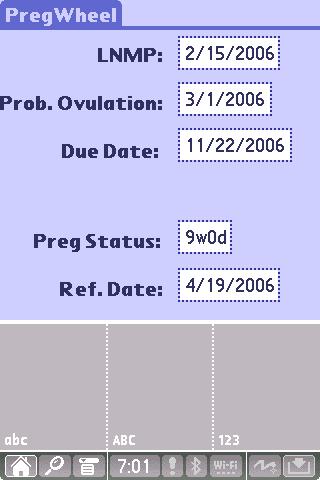
Pregwheel is a program that has replaced the cumbersome wheel that I usually carry around (and lose :)). It is a freeware program and can be found on PDAMD.COM or www.healthypalmpilot.com. It doesn't do alot of fancy tricks and it is so deceptively simple that I thought that it would be worth a shout on my pages after having used this for a few years.

Essentially, this program does exactly as it states. It substitutes for a pregnancy wheel. You put in your LNMP and your reference date (ie. today) and it produces a host of information, including the date of probable ovulation, the estimated due date and of course the pregnancy status (ie. number of weeks pregnant).

However, where this program excels is in its simplicity. The program shows only 5 lines of data:

LNMP
Prob. Ovulation
Due Date
Preg Status
Ref. Date.

That's it!

But You get the added bonus of being able to enter all but the Pregnancy status as your initial point of entry. This is a God-Send when you have an ultrasound report giving a due date that is off by several weeks. You can even change the reference date to reflect how far along the patient was when the ultrasound was taken.

Given the days of Google, where simplicity and an uncluttered screen are the order of the day, I have found this program immensely helpful when someone walks into the office for the first time. It's easy to use Nagel's rule to calculate the due date, but attempting to figure out how far along the patient is without using a wheel is a little more complicated.

This program has been out for a very long time, but it still stands the test of time and works extraordinarily well on the LIFEDRIVE.

LDD.